×
![]()


Strong communication between trauma registrars and trauma program managers forms the backbone of an effective trauma program. When registrars know the right questions to ask, they unlock clearer expectations, stronger data quality, and better support for performance improvement. This guide outlines practical, professional questions that help registrars partner more effectively with leadership while advancing patient care and regulatory compliance.
Trauma registrars sit at the crossroads of clinical documentation, coding standards and data submission requirements. Meanwhile, trauma program managers oversee the broader program, including performance improvement and patient safety, or PIPS, education, staffing and compliance with American College of Surgeons standards. Bridging these roles through thoughtful questions builds mutual understanding and drives continuous improvement.
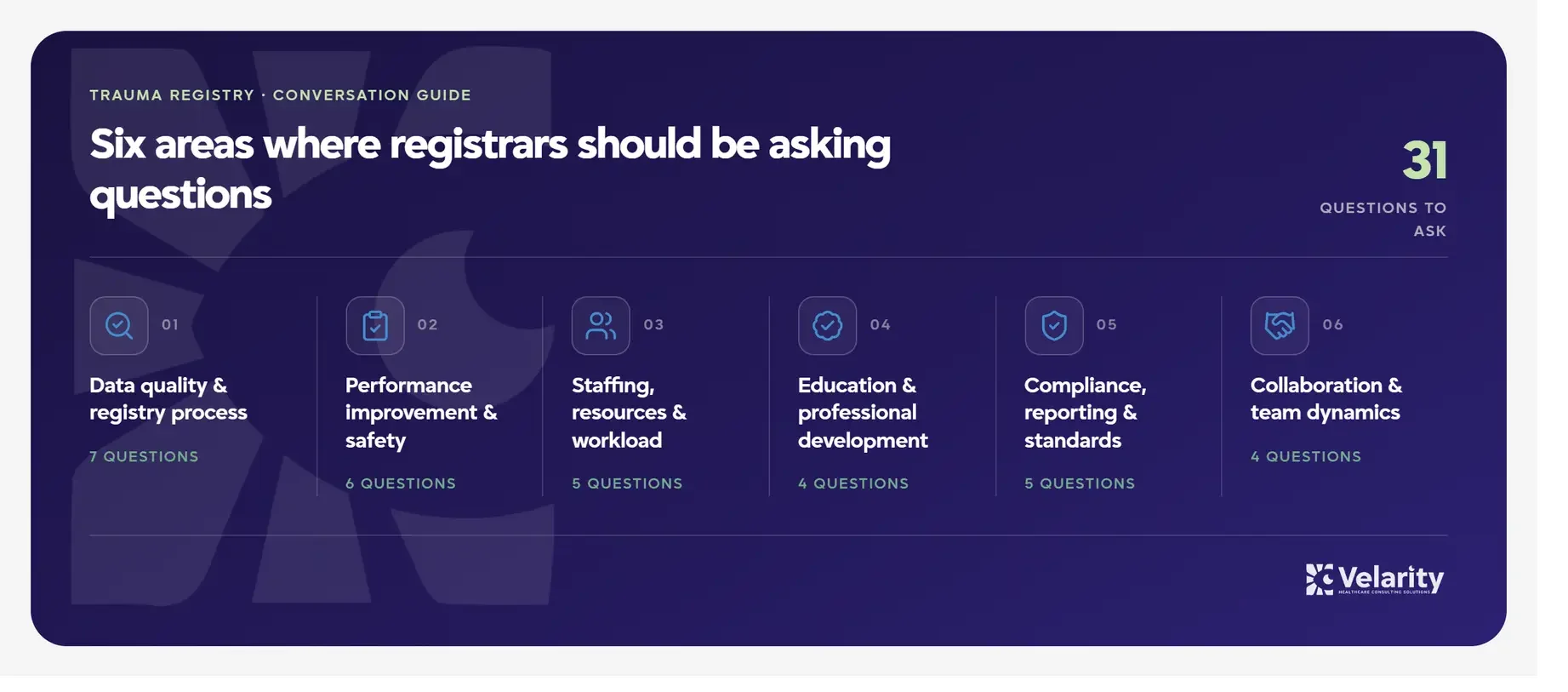
Why Trauma Registrars Should Ask Questions of Program Managers
Open discussion prevents assumptions, reduces friction, and allows for a calmer presence in the department. Registrars often notice patterns in documentation gaps, electronic medical record permissions, coding challenges or workload pressures that managers may not see daily. By asking questions, registrars identify issues early, clarify priorities and align their work with program goals. In turn, managers gain frontline insight that strengthens decision-making.
Furthermore, the American College of Surgeons emphasizes registry oversight as a responsibility of the trauma program manager. Clear communication supports compliance with standards related to staffing ratios, data quality plans, education requirements and timely submissions to the National Trauma Data Bank and Trauma Quality Improvement Program. Asking the right questions helps both parties meet these expectations.
 Questions About Data Quality and Registry Processes
Data quality sits at the heart of the trauma registry. Accurate abstraction, consistent coding and timely closure of records enable meaningful reporting and reliable benchmarking. Registrars should therefore seek clarity on expectations and processes.
Clarifying Inclusion Criteria and Workflow
Consider asking the following:
Supporting Validation and Inter-Rater Reliability
Additional useful questions include:
 Questions About Performance Improvement and Patient Safety
The trauma registry drives the performance improvement and patient safety program. Registrars who understand how their data supports PIPS become stronger teammates in improving outcomes. Asking about the connection between registry work and quality initiatives helps align daily tasks with larger goals.
Key questions to raise include:
 Questions About Staffing, Resources and Workload
Adequate staffing remains a frequent challenge in trauma registries. The American College of Surgeons recommends at least 0.5 full-time equivalent registry staff for every 200 to 300 annual patient entries. When volume grows or software changes create new burdens, registrars need clear avenues to discuss capacity.
Questions in this area include:
 Questions About Education, Training and Professional Development
Trauma registrars must maintain specialized knowledge in Abbreviated Injury Scale (AIS) coding, ICD-10 coding, trauma registry principles and evolving national standards. Program managers oversee education requirements and can help registrars access the right resources.
Ask about professional growth with questions such as:
 Questions About Compliance, Reporting and Standards
Trauma centers must submit accurate data on set schedules to state registries, the National Trauma Data Bank and the Trauma Quality Improvement Program. Registrars carry much of the responsibility for these submissions. Clarifying timelines, validation steps and contingency plans reduces last-minute stress.
Helpful compliance-focused questions include:
 Questions About Collaboration and Team Dynamics
Effective trauma programs depend on teamwork across registrars, the trauma program manager, the trauma medical director, performance improvement coordinators and clinical teams. Registrars who understand communication preferences and meeting structures can contribute more effectively.
Consider asking:
How Trauma Registrars Can Approach These Conversations Effectively
Asking questions works best when asked constructively. Approach conversations with curiosity and a problem-solving mindset rather than frustration. Prepare specific examples of challenges or opportunities. Approach any discussion regarding a problem that has been identified with a possible solution to that problem. Managers respond more readily when they hear both the issue and thoughtful ideas for addressing it.
Schedule dedicated time rather than relying solely on hallway conversations. A brief, focused agenda helps keep discussions productive. Follow up in writing with key takeaways and agree on the next steps so both parties share the same understanding. Over time, regular dialogue builds trust and makes future conversations easier.
In addition, share positive observations. Highlighting what works well reinforces good practices and balances the discussion. Trauma program managers often juggle many competing demands; hearing that registry processes support the larger program can strengthen partnership.
Putting These Questions into Practice
Start with one or two high-priority areas rather than attempting every question at once. Data quality and submission timelines often provide natural starting points. As rapport grows, expand into staffing, education and broader collaboration topics. Document agreements and revisit them periodically as volume, software or standards evolve. Come with any documentation that will help your discussion.
Remember that the goal is mutual success. When trauma registrars ask thoughtful questions of their trauma program managers, they demonstrate ownership of their role and commitment to the program’s mission. Managers who welcome these conversations gain valuable insight and can better advocate for the resources the registry needs.
Conclusion: Building Stronger Partnerships Through Curiosity
The questions trauma registrars should ask their trauma program managers cover data quality, performance improvement, staffing, education, compliance and teamwork. Each question opens a door to clearer expectations, better support and stronger patient outcomes. By approaching these conversations with professionalism and a spirit of teamwork, registrars and managers together create the foundation of high-quality trauma care.
Trauma registries succeed when the people closest to the data feel empowered to seek clarity and share insights. Use the questions as a starting point, adapt them to your solutions, and keep the dialogue going. Continuous communication remains one of the most effective tools available for improving trauma systems.
Ready to strengthen communication within your trauma program? Share this article with your team, schedule a focused conversation with your trauma program manager, or reach out to explore resources that support trauma registry excellence. Contact us at trauma@velarityhcs.com to learn more about best practices, education opportunities and tools that help trauma registrars and program managers work together more effectively.
Have additional questions or success stories about registrar-manager collaboration? We would love to hear how these conversations are improving your trauma program.
Additional Resources
For further reading on trauma registry standards and program leadership, consider these sources:
