×
![]()


It was Christmas 2025, and I wanted to update my family’s set of computers. My kids’ four-year-old laptops were showing signs of heavy memory consumption from games, school and the normal wear of systems updating. An easy and historically simple fix was to upgrade the RAM. Their computers would double in memory, and this was usually a minor spend for a literal five-minute fix.
As I reviewed the prices, I was floored. What I thought would cost around $300 for all the computers in my house was nearly $600. I compromised, skipped the higher-end kits for the laptops, and then it hit me: what in the world happened to RAM? The answer, it turns out, runs straight through artificial intelligence (AI) and my day job in health information management (HIM). That rabbit hole became this article.
AI in healthcare is usually discussed as a software story: ambient scribes, coding assistants and clinical decision support. The bigger story right now is physical. Consumer demand for AI arrived before the world’s infrastructure was ready for it, and the resulting strain on chips, cloud capacity and the power grid is reshaping what tools healthcare organizations can afford and access. In this article, we will move from macro to micro: what makes this AI wave different, how it broke the hardware supply chain, why the ripple hits healthcare directly and what HIM professionals should do about it.
AI has had false starts before. From the 1950s through the 1990s, expert systems and early neural networks repeatedly outran their capabilities, producing the famous “AI winters.” The 2000s and 2010s brought a machine learning revival powered by big data, and the transformer architecture introduced in 2017 set the stage for the generative models we use today.
What changed in 2023 was the audience. ChatGPT reached 100 million users in two months. For comparison, Netflix took three and a half years to hit that mark and Instagram took two and a half. Previous AI advances lived in academia and the enterprise; this time, consumer demand exploded before data centers, chip fabricators and power utilities were prepared for it. That mismatch is the root cause of nearly everything that follows.
Three forces then collided. Consumers, enterprises and governments all wanted AI at once. Big Tech capital expenditures surged toward $300 billion per year, flowing faster than infrastructure could absorb it. Meanwhile, the hardware simply could not scale: a semiconductor fabrication plant costs $10 billion to $20 billion and takes three to five years to build, and no amount of money accelerates physical construction.
AI accelerators rely on high-bandwidth memory (HBM), a premium form of DRAM produced in the same fabrication plants that make the standard DDR5 random access memory (RAM) inside ordinary computers. Because HBM margins are dramatically higher, Samsung, SK Hynix and Micron all pivoted production toward it. Capacity allocated to HBM is capacity that cannot simultaneously make consumer memory. That was a deliberate economic choice by the manufacturers, not a supply accident.
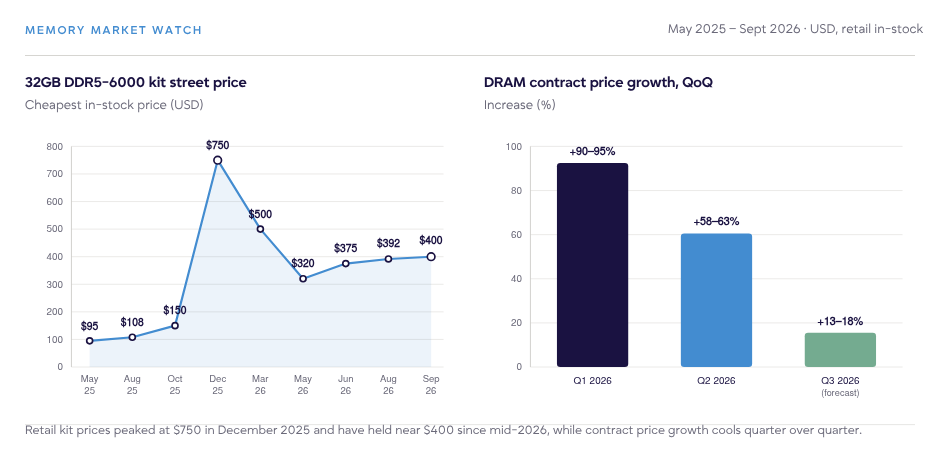
The consumer market felt it immediately. Reporting from late 2025 put dynamic random access memory (DRAM) prices up 171% year over year and NAND flash up 246%, with a 32-gigabyte DDR5 kit jumping from roughly $95 to $750 before settling near $500. Micron went further and exited the Crucial consumer business entirely after 29 years, and some prebuilt computers began shipping without memory installed at all. Industry voices such as TeamGroup warned that normalization may not arrive until late 2027 or 2028.
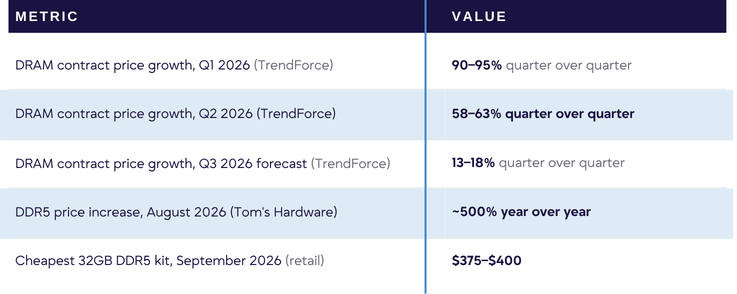
The warnings held up, and then some. TrendForce tracked conventional DRAM contract prices rising 90% to 95% quarter over quarter in the first quarter of 2026 and another 58% to 63% in the second, the steepest increases in the memory market’s history, before decelerating to a forecast 13% to 18% for the third quarter. In August 2026, Tom’s Hardware measured DDR5 prices up roughly 500% year over year. As of September 2026, the cheapest 32-gigabyte DDR5 kit at retail sits around $375 to $400. That is well below the December 2025 panic peak, but still roughly four times its pre-crisis price.
Looking forward, the signals are mixed. Analysts including International Data Corporation (IDC) and Counterpoint expect prices to peak in late 2026 before a slow moderation, and the quarterly deceleration supports that. However, hyperscale AI buyers have reportedly locked in nearly all global DRAM production for 2027 with advance deposits, SK Hynix’s chief executive has warned 2027 could be the industry’s worst-ever memory supply year for everyone else, and the company separately cautioned that tight conditions could persist past 2030.
Graphics processing units (GPUs) matter far beyond gaming because AI inference, which is running a model in real time, happens on GPU clusters. The same memory shortage drives GPU costs, since memory has become the most expensive part of building a modern card. The trajectory projected in early 2026 arrived on schedule. The flagship RTX 5090 launched at a $1,999 suggested price; by August 2026 its median United States street price was about $4,700, and the cheapest in-stock cards crossed $5,000 in September, more than two and a half times launch price. NVIDIA reportedly cut consumer production 30% to 40% to prioritize higher-margin data center chips. That same constrained inference capacity contributes to the ambient scribing waitlists and coding AI rollout delays healthcare organizations are experiencing, alongside the usual procurement, integration and review timelines.
Month-by-month price tracking for the card is maintained by TrackaLacker.
Original equipment manufacturers (OEMs) passed the costs along. ASUS, Dell, Lenovo, HP and Acer warned of price increases ranging from 10% to 30%, and IDC projected the personal computer market could shrink 9% in 2026, the worst decline since the 2009 financial crisis, landing just as the Windows 10 end-of-life refresh cycle forced organizations to buy.
Hardware is only half the strain; electricity is the other. PJM, the regional grid operator serving 65 million people, projected a 6-gigawatt shortfall by 2027. In central Ohio, residential rates climbed about 60% over five years as 130 data centers came online, and Carnegie Mellon researchers projected electricity-bill increases of up to 25% in the highest-demand markets by 2030.
The cloud, in turn, is a building with a power bill, and those buildings are full. Microsoft’s own fiscal 2026 annual report names power availability as a constraint on data center expansion. Its chief financial officer told investors in early 2025 that the company had been “short power and space,” and by the October 2025 earnings call was still reporting the company had been short “now for many quarters” despite record building.
Chief executive Satya Nadella put it more bluntly: Microsoft had chips sitting in inventory it could not plug in for lack of powered data center space, with roughly $80 billion in Azure orders reportedly backlogged behind the constraint. Even after activating 88 new data centers in fiscal 2026, capacity restrictions persisted in regions from Northern Virginia and Texas to the United Kingdom. For healthcare, the takeaway is direct: organizations relying on cloud-based AI may face capacity waitlists, allocation constraints in certain regions and potentially higher subscription costs as vendors absorb increased infrastructure expenses.
These macro disruptions land on healthcare in four specific ways:
Smaller facilities are disproportionately exposed. A large academic system can absorb subscription hikes and buy ahead of shortages; a 25-bed critical access hospital cannot. Consequently, the AI capability gap risks mapping onto existing rural health disparities, which makes this a governance issue as much as a budget one.
Despite the constraints, adoption is accelerating because the problems AI addresses are enormous. Published industry and academic estimates put annual administrative waste in United States healthcare around $360 billion. Physician surveys describe dozens of hours per week lost to administrative work, including prior authorization. On the HIM side, workforce surveys estimate a roughly 30% shortage of qualified coders, and separate industry analyses have tracked coding-related denials surging by more than 100% in recent years.
The numbers show demand for finding a way. Menlo Ventures’ State of AI in Healthcare report put domain-specific AI use at 22% of healthcare organizations, a sevenfold increase in a year, with ambient scribing revenue reaching $600 million; the same report found two-thirds of Epic hospitals running ambient documentation. Mayo Clinic has reportedly committed more than $1 billion to AI initiatives. When a flagship academic medical center invests at that scale, it signals where the industry is heading, not where it might go.
For HIM professionals, the honest answer to “will AI take my job?” is that it will change it. Industry surveys suggest roughly 70% of health systems are prioritizing AI coding automation, and those tools need humans to validate suggestions, review exceptions and catch systematic errors. Coders become auditors; abstractors become validators.
The shift moves the profession up the value chain in four areas. Routine coding and data entry shrink, while complex case work, AI oversight, data governance and compliance grow. AI models are only as good as the data they learn from, and clinical documentation quality, coding accuracy and data integrity are precisely what HIM has owned for decades. Additionally, AI-suggested coding should be supported by an audit trail. When a claim is denied, someone must explain what the AI did and why a human approved it. That is HIM work.
The professionals who embraced electronic health record adoption in the 2000s did not just survive; they became the implementation experts everyone turned to. The same opportunity exists right now.
Real obstacles remain, and pretending otherwise helps no one. Payers deployed AI denial algorithms faster than providers deployed AI coding tools, and in my view that imbalance is a major driver behind the denial surge. That arms race is already underway. Privacy questions follow every cloud AI tool: where does patient data go, does the business associate agreement (BAA) cover it and is the vendor prohibited from training on it? Accuracy and liability are genuinely unsettled, which is why most coding AI is positioned as suggestions requiring human review. Finally, integration complexity is growing as EHR vendors race to bolt on point solutions.
The transition has a rough shape, though the timeline has stretched since the crisis began. The pace of price increases is decelerating, and analysts expect memory prices to peak in late 2026. Even so, with hyperscalers pre-booking 2027 production, elevated prices and tight supply likely persist through 2027 for everyone else. Meaningful relief follows in late 2027 and 2028 as new fabrication capacity from Micron, Samsung, TSMC and SK Hynix ramps up across Idaho, New York, Arizona, Texas and Indiana. By 2029 and beyond, the market should move toward a new equilibrium, though some industry warnings stretch past 2030. Healthcare AI matures in that window, and early adopters hold years of operational experience over organizations that waited.
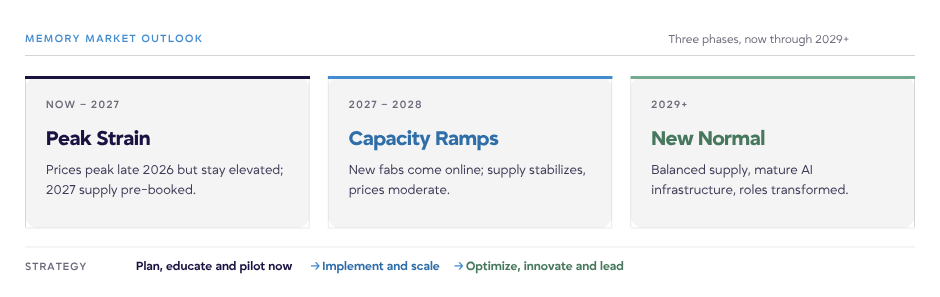
The key message: waiting carries its own cost. In healthcare, where implementation failure carries patient safety risk, the experience gap between early adopters and laggards compounds. Use the constrained period to plan, educate and pilot so you can implement and scale the moment capacity loosens.
The American Health Information Management Association (AHIMA) publishes AI policy statements and practice guidance for the profession. Menlo Ventures’ State of AI in Healthcare report is freely available, and the International Energy Agency (IEA) tracks data center energy demand projections cited throughout this article.
The supply chain crisis, the energy strain and the price shocks are symptoms of a transition moving faster than its infrastructure. Transitions create disruption and opportunity, and HIM is positioned to capture the latter: protecting patient information, ensuring data quality and leading with integrity.
