×
![]()


How do you know when a healthy registry begins to become unhealthy? Most registry leaders would answer, “When productivity declines.”
I don’t think that’s the first indicator, or even the most important one. Cancer registry performance can stay strong for a long time while the registry behind it is getting weaker. The work still gets done, and the numbers look good.
By most traditional measures, the registry appears healthy. But is it getting stronger? That is a different question, and it is the one I find myself asking more often.
I think of this as organizational drift: the gradual loss of processes, knowledge, flexibility and resilience that happens even while day-to-day performance holds steady. Looking back over 20 years in this profession, I cannot recall a single registry that became unhealthy overnight.
Drift rarely starts with a major event. It starts with small decisions that make perfect sense at the time.
Education gets postponed because reporting deadlines are pressing. A process meant to be temporary slowly becomes the way things have always been done. Before long, everyone leans on the same one or two experienced staff members, not because it is the right structure but because it is faster than slowing down to teach someone else.
None of those decisions feels significant, and most are made with good intentions. A temporary workaround is not a concern on its own. Postponing one educational opportunity will not change the health of a registry, and leaning on your most experienced staff member when something complicated arises is often exactly the right call. But when temporary decisions become permanent ones, something shifts.
Knowledge becomes less distributed, and processes become more dependent on habit. There is less time to step back and ask whether the way the work is being done still makes sense. The registry may be every bit as productive as it was before. What has changed is its ability to adapt.
That’s what makes drift so hard to catch. From the outside, everything still looks healthy. Reporting deadlines are met, quality remains strong, and no backlog is demanding attention.
If you looked only at the monthly dashboard, you would conclude that nothing has changed. But dashboards tell us what is happening. They do not tell us how we are getting there.
Consider two registries reporting nearly identical productivity, quality, and timeliness. The first meets its goals because knowledge is shared, workflows are well designed, staff understand one another’s responsibilities and processes have evolved as the registry has changed. The second produces the same results in a different way. Its workflows are a set of workarounds that were never meant to be permanent, its staff know their own queues and little about anyone else’s, its processes were designed for a caseload it no longer has, and it meets its deadlines because a few people have learned to make all of that work.
On paper, those registries look alike. Organizationally, they are not.
In the second registry, experienced Oncology Data Specialists become very good at filling gaps. They remember the step that was never documented. They know who to call when an interface does not work correctly. They recognize the unusual case that needs a second look, and they know which report has to be adjusted by hand before anyone can use it.
Over time, those accommodations become almost invisible, and there’s nothing wrong with that; experience is one of the greatest strengths a registry has. The risk comes when individual expertise begins to substitute for organizational capability. If only one person understands a critical process, the registry does not own that knowledge. The individual does.
None of this makes the measurement side less important, and Velarity’s practical framework for Oncology Data Specialist productivity and workforce planning covers benchmarking and case complexity in detail. But those numbers answer one question.
So instead of asking only, “How are we performing?” we should also be asking, “What is allowing us to perform this way?” The answer will tell you more about the future health of your registry than the number itself.
Eventually, every registry is tested. Sometimes it is retirement or an unexpected resignation. Sometimes it is a software conversion that demands far more time than anyone anticipated, a surge in case volume, or a new reporting requirement that stretches an already busy team.
Those events do not create organizational weakness. They reveal how much capability was there all along.
I have walked into at least two registries where the manager had been gone for a year or more. The staff who remained knew some of what that manager had known, but not most of it. That’s not a criticism of them. Day-to-day staff are not expected to carry out a manager’s full scope of duties, and it would be unreasonable to ask them to.
Some gap is unavoidable when a leader departs. A position has to be approved, posted, filled, and then learned, and that takes time no matter how well run the registry is. What determines the size of that gap is how much was shared before anyone knew it would be needed.
In both cases, very little had been. There was no cross-training in place and no plan for the day the manager left, so a handover that could have been managed became a long stretch of improvisation.
The staff kept the registry going anyway. Required reporting went out, minimum standards were met, and from the outside the registry was still working. What that cost them did not appear anywhere in those numbers. Covering the pieces nobody had been prepared to cover took time out of their own daily responsibilities, and that work fell behind.
Neither departure made anyone less capable. Each exposed a leadership gap that had been sitting there all along, waiting for the day someone walked out the door. Before that day, there was no reason to question any of it, because the work was getting done.
I have spent a good part of my career saying that our profession needs to develop registry leaders before we need them. This is what it looks like when we don’t.
That’s why disruption is such a useful test. It is the moment when two registries that looked identical on paper start to look very different in practice. One adjusts and keeps moving; the other struggles to regain its footing.
A growing backlog works the same way. It tells you something has shifted, but it is not a diagnosis on its own, and a response that does not match the actual cause will not hold.
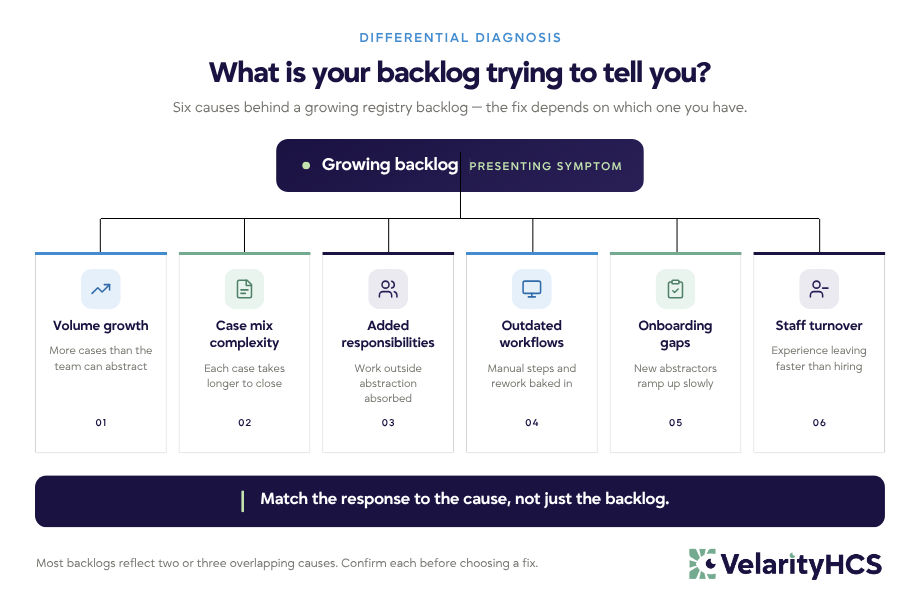
Several factors can produce the same visible backlog:
All of the above produce the same visible result. Each one calls for a different response. Most backlogs reflect two or three overlapping causes rather than a single one, which is why the first question is not “how do we catch up” but “what is actually driving this.”
What I saw in those registries is not unusual, and the workforce data supports it. The Cancer Registrar Workload and Staffing Study, conducted by the University of California, San Francisco (UCSF) Health Workforce Research Center and published in the Journal of Registry Management in 2024, examined workload and staffing alongside the future needs, skills, and training of the cancer registry workforce.
Registry leads reported that nearly half of their staff (49.1%) needed additional training in data analysis, and 17.8% of registrars surveyed said they planned to retire or leave the profession within five years. Interviews pointed to vacancies and burnout alongside those pending retirements. The study also concluded that technological innovation and automation are likely to change the registrar’s role rather than eliminate it.
National Cancer Registrars Association (NCRA): Workforce Resources and Research
That picture makes building organizational capability more urgent, not less. Preparing a registry for the future is not a matter of counting how many people you need today. It is about deciding what knowledge, skills, and flexibility the registry will need as the work itself changes.
Resilience deserves as much attention as productivity. Productivity tells us how we are performing today. Resilience tells us how we will perform when today’s conditions change, and they will.
Resilience doesn’t mean carrying excess staff or preparing for every possible disruption. No registry can predict every resignation, technology change, reporting requirement, or increase in volume. It means building enough capability into the registry that change does not depend entirely on heroic effort.
That capability takes different forms like the following:
We tend to improve processes only when they fail, but resilient registries question them while they are still succeeding, not because everything needs to change but because the circumstances around the work do. Much of that rests with the people leading the registry, a subject Velarity HCS takes up in its piece on empowering cancer registry managers.
The healthiest registries I’ve seen didn’t constantly reinvent themselves. They stayed curious enough to ask whether their current way of working still supported where they were going.
The encouraging part is that resilience is not built during a crisis. It’s built in ordinary moments, the ones that do not feel significant at the time.
Moments like:
None of those efforts produces an immediate jump in productivity, and some require time that feels as though it could be spent more productively elsewhere. That’s not the point. Organizational capability is rarely created through one large initiative.
It develops the way drift does, through small decisions nobody flags at the time. The difference is direction.
As you think about your own registry, consider these questions:
A healthy cancer registry is not defined only by the results it produces today. It is also reflected in the capability it is building for tomorrow. Productivity, quality and timeliness will always matter. The question I would ask is the one I started with: Is the registry getting stronger, or only keeping up?
Resilience is built through choices made long before that strength is ever tested. That is the hard part. Those choices must be made during the long stretch when nothing about the registry appears to require them.\
Most registries never get a clear look at what is holding their performance up until something forces the question. It is an easier question to answer before something does.
Velarity’s Cancer Registry Services include:
If you are ready to look beyond your own numbers, contact us to learn more.
