×
![]()


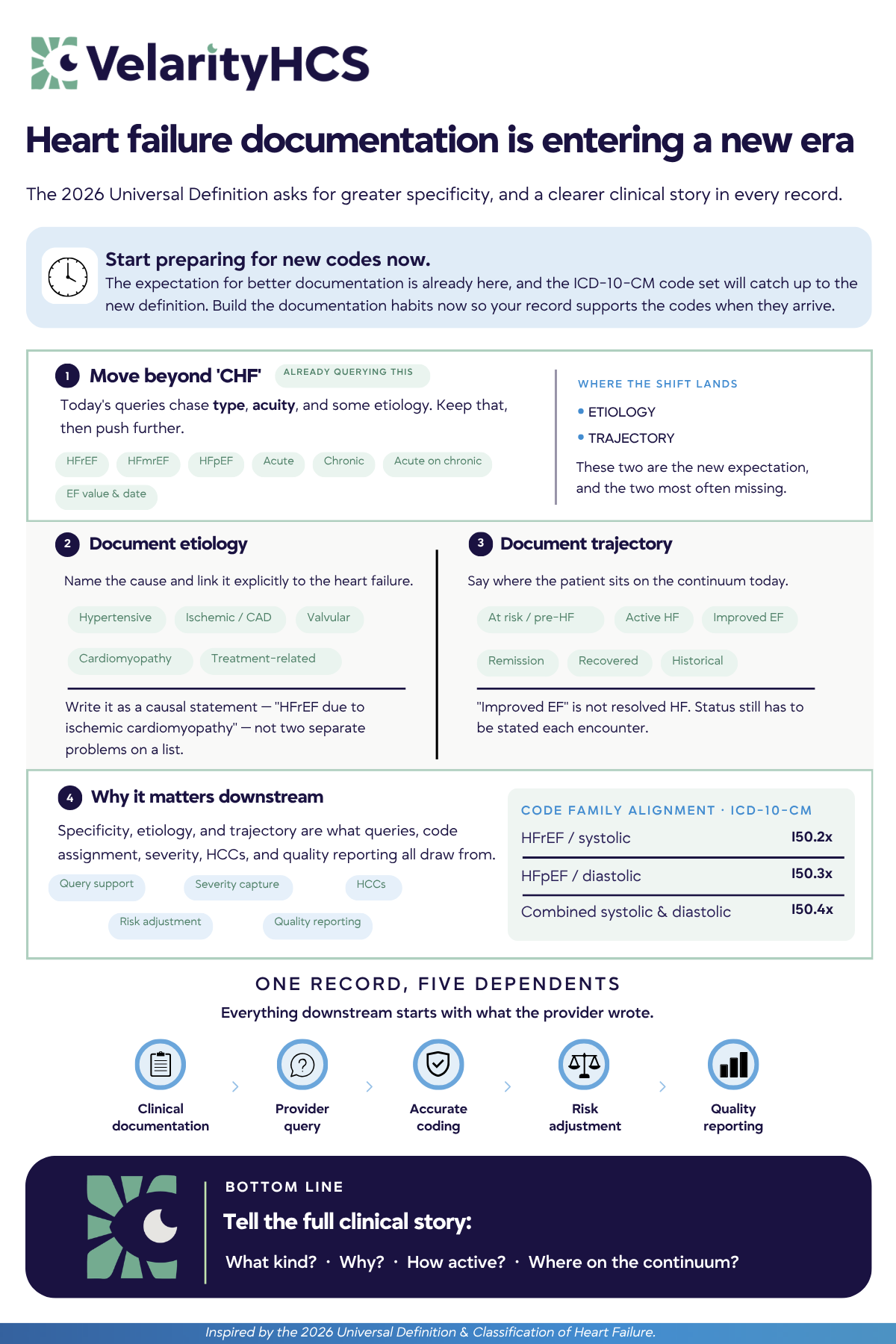
Heart failure documentation is entering a new era, and “CHF” is no longer enough.
The 2026 AHA/ACC/ESC/WHF Second Universal Definition of Heart Failure reinforces what CDI and Coding professionals have long known: accurate heart failure capture depends on specificity. While this update does not introduce new ICD-10-CM codes, it does signal an important shift in clinical language and documentation expectations.
As clinical definitions evolve to better reflect heart failure type, acuity, etiology, ejection fraction phenotype, and disease trajectory, documentation must evolve as well. For CDI teams, this creates an opportunity to strengthen provider education, improve query impact, and support more accurate severity, quality, and risk adjustment reporting. For Coding teams, it reinforces the need for clear provider documentation that supports precise code assignment using existing code sets.
The future of heart failure documentation is not simply identifying that heart failure exists. It is clearly documenting what kind, why it occurred, how active it is, and where the patient is on the disease continuum.
Key CDI Implications
While “CHF” remains common in documentation, it is increasingly insufficient for accurate CDI review and coding.
The updated definition reinforces the need to document:
Instead of documenting only “CHF,” providers should be encouraged to specify:
The updated definition’s emphasis on classifying heart failure causes makes etiologic specificity increasingly important. [1,2]
CDI Query Opportunities
Heart failure documentation may support a query when clinical indicators are present but documentation lacks clarity regarding:
The key CDI question becomes:
Does the documentation tell the complete clinical story of the patient’s heart failure?
The universal definition continues to recognize patients with structural heart disease, biomarker abnormalities, or cardiac dysfunction without classic symptoms as being in a pre-heart failure stage. [1,4]
From an inpatient CDI perspective, pre-HF may not typically drive MCC or CC capture. However, it is increasingly relevant to:
For organizations expanding outpatient CDI or risk adjustment work, this concept may become more important over time.
A major documentation implication is the recognition that heart failure is dynamic. Patients may experience improvement, remission, or recovery rather than remaining in a fixed disease state. [1–3]
This matters because vague statements such as “history of CHF” may not accurately describe a patient whose heart failure remains clinically active and managed.
Documentation may need to distinguish between:
For CDI and Coding teams, this distinction affects severity capture, risk adjustment, clinical communication, and longitudinal documentation accuracy.
Key Coding Implications
The updated definition moves away from overly rigid ejection fraction cutoffs and broadly recognizes heart failure phenotypes such as:
The document also acknowledges that patient-specific factors may influence interpretation of EF and disease phenotype. [1,2]
From a coding perspective, ICD-10-CM codes have not automatically changed because of this clinical definition update. Coders should continue assigning heart failure codes based on provider documentation.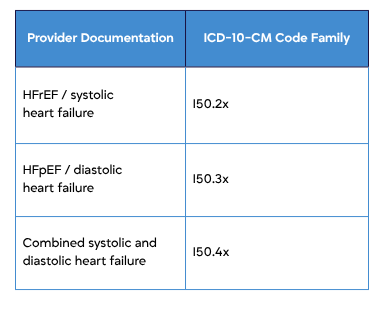
However, CDI teams should anticipate evolving terminology from cardiology societies and monitor for potential future coding guidance changes.
The updated universal definition emphasizes classification of heart failure causes. This is highly relevant for CDI and Coding because cause-and-effect documentation can support more complete code assignment and clinical specificity. [1,2]
Examples include:
For coding accuracy, the provider must clearly document the relationship between heart failure and the underlying condition when required.
Although the universal definition is clinical rather than coding-specific, improved heart failure specificity supports many CDI and Coding priorities, including:
Documentation that clearly identifies heart failure type, acuity, severity, etiology, and trajectory remains essential for both inpatient CDI and outpatient risk adjustment work.
CDI Educational Takeaways
For CDI education, five key messages should be emphasized:
Providers should be encouraged to document heart failure type, acuity, etiology, EF phenotype, and clinical trajectory.
CDI teams should ask:
What caused the heart failure?
The answer may involve hypertension, ischemic disease, valvular disease, cardiomyopathy, infiltrative disease, treatment-related causes, or other clinical conditions.
Heart failure status should reflect current clinical reality. If the patient has improved EF, remission, or recovery, that distinction should be documented clearly.
Heart failure is increasingly viewed as a disease continuum rather than a single encounter diagnosis. This is especially important for ambulatory CDI, HCC education, and population health programs.
Current ICD-10-CM code families remain in use, but CDI and Coding teams should monitor future coding guidance as clinical terminology continues to evolve.
Bottom Line for CDI Leaders
The documentation opportunity is not simply to code heart failure. It is to tell the full clinical story.
References
